Author Archives: kaylynnemglover

House Bill Tackles Grad School Mentorship Problems

Representative Jennifer McClellan’s (VA-04) office has released legislation targeted at improving mentorship in graduate education. The bill, titled the Improving Mentorship in STEM Higher Education Act, authorizes $5 million of NSF grants to efforts that improve mentorship practices in graduate education. Areas of focus include investing in research into best mentorship practices for graduate education and investing in programs that train researchers and faculty and that institutionalize evidence-based mentorship practices.

We applaud Congresswoman McClellan’s focus on improving mentorship and preventing abuse in graduate education. Research mentors are responsible for overseeing these students as they work through their degrees and for preparing them for successful scientific careers. This is an essential workforce and talent pool for American technology development and national security, and ensuring their mentors are engaged in ethical and evidence-based practices can go far in addressing the systemic workplace issues that have resulted in only half of doctoral students graduating and usually only after 6-8 years. The FAARM Project joins other organizations endorsing this bill, including the National Association of Graduate Professional Students (NAGPS), Association for Women in Science and the Council of Graduate Schools, and the MIT Graduate Student Council.

The bill, which would begin awarding grants in 2025, is being introduced into the House Science, Space, and Technology Committee. The full list of members is listed below. We urge you to review this list and to contact any members that represent you, asking them to support this bill.

RepublicansDemocrats
Frank Lucas (OK-03) – ChairZoe Lofgren (CA-18) – Ranking Member
Jay Obernolte (CA-08)
Chuck Fleischmann (TN-03)
Darrell Issa (CA-50)
Rick Crawford (AR-01)
Claudia Tenney (NY-24)
Scott Franklin (FL-15)
Dale Strong (AL-05)
Max Miller (OH-07)
Rich McCormick (GA-06)
Mike Collins (GA-10)
Brandon Williams (NY-22)
Tom Kean (NJ-07)
Vince Fong (CA-23)
Greg Lopez (CO-06)
Randy Weber (TX-14)
Suzanne Bonamici (OR-01)
Haley Stevens (MI-11)
Jamaal Bowman (NY-16)
Deborah Ross (NC-02)
Eric Sorensen (IL-17)
Yadira Caraveo (CO-08)

Dear Future PhD Student

Going to grad school to get a PhD? We’ve been there, and there are things that we wish we had known back when we were right where you are now. Things that you don’t often find in the offices of advisors tasked with helping you get accepted. Things that universities don’t advertise. 

And what all that advice comes down to risk management. Right at the beginning, when you make the decision to go and where to go, you have a whole risk management project you need to work through, but you will not be told everything you need to assess and manage those risks. Your professors and university leaders will not warn you about all the problems with the work and learning environment. They will not warn you about the statistics – that 40 to 50% of the people that start a PhD never finish it. They will not warn you that the problems those people faced were often outside their control. They certainly won’t warn you how unclear the actual requirements to finish a PhD can be or how much singular control your advisor may have over the process. 

As former doctoral students and long-term advocates for graduate student well-being, here’s what folks on the FAARM team wish we had known before starting our own programs: 

#1 – You need to have multiple specific project ideas in a specific research area that you’re really motivated about.  

Having multiple project ideas reduces your likelihood of getting stuck in a narrow niche or dead end. Between shifting committee preferences, changing priorities at funding organizations, and new research that may disprove your idea, a lot of things can happen that throw a wrench in your first (and second, and third) project idea. You should have several feasible projects that you could turn to, just in case. And they should be different enough from each other that they could stand alone – if all of your ideas depend on the same assumption or funding source, you could end up in trouble. 

Plus, having specific project ideas will help you have more productive conversations with faculty and potential advisors, as this will give you more ways for their ideas and advice to integrate with yours. This will bolster their interest and investment in your research.

#2 – You need to know the program or department you’re applying to has at least 2 faculty that would be ready, willing, and able to advise your project. 

Your advisor has inordinate control over your degree, and you will not be able to graduate without an advisor who will sign off on your work. So you should have an idea of what you’ll do if something disrupts your relationship with your advisor: if they move to another university or their position at the university changes, or if they end up being toxic and difficult to work with, or even abusive to you or someone else (the stats on faculty-to-grad student sexual assault are still frighteningly bad, even after years of the Me Too movement). In short, you need to be in a position where you have the genuine practical ability to switch advisors and finish your work, just in case. 

#3 – You need to know where the funding, data, and other essential inputs to your project are coming from in very clear and specific terms. 

Many students start their PhDs without knowing enough about the logistics of research funding and resources, and this often comes back to haunt them. It’s important for you to be aware that, throughout your PhD project, your funding situation – for both your research and your livelihood – can change rapidly and that the details of these sources (e.g., who can access them and why) matter. 

If you happen have all of those inputs in hand at the time you apply (like, you have already been awarded the money and are ready to do this), you are coming into grad school at a major advantage. For most potential PhD students, though, this is completely impossible, especially the funding part, since that’s often tied to a specific faculty member. In general, PhD students do not control any research funding. 

As you interview with faculty or rotate through labs during the first year of your program, you should be proactive: ask lots of detailed questions about where the funding, data, software, hardware, and other essentials come from in their current projects so that you can get an idea of how solid those sources are. Tying yourself to an unstable financial source isn’t wise.

#4 – Despite the academic job market, you need to have “Tenured Professor” among your Top 3 career options. It doesn’t have to be your #1, but it should be on the list. 

Being a tenured professor is a lot more about teaching, administration, and trying to get grant funding than it is about actually doing research. As students progress through their degrees, they often find themselves looking at career paths outside of academia where they can focus more on research and less on the needs of a university. 

But unfortunately, there is just not a lot of institutional support for those who are interested in those paths. Even though the demand for PhDs outside of academia continues to rise, there is still a very strong cultural expectation that most PhDs in most fields will become professors. While this has not actually applied in any practical way in 20+ years, most current faculty were raised and trained in an environment that very strongly held this expectation, and it still shapes a lot of their thinking and behavior. As a result, you will learn a lot about tenure-track academic hiring just by being in academia – about openings, recruitment, interviewing, hiring, and the tenure process. In contrast, you will learn a lot less about private sector opportunities, and faculty will be less helpful in finding and pursuing them. And unless you very actively seek it out, you will be told almost nothing about government and non-profit jobs. 

What this boils down to is this: Most of the career advice you will be exposed to will only be applicable if academia is in your cards. If you want to even consider other paths, you will have to spend a lot of time and energy learning about those markets yourself, and you’ll be dipping into your already cramped time and energy budget. So while you may not want to go into academia, the path to it will be clearer (albeit harder) than others, and you should keep it open, just in case. If you would rather do anything else than be an academic, you should strongly reconsider this whole venture.

Plus, this can help you get accepted into a PhD program to begin with. A lot of the senior people in academia still like the idea of working with a PhD student who’s eager to “follow in their footsteps.” Remember, this whole thing is basically an apprenticeship, and a weirdly old-fashioned one. You should expect this to affect the way you get evaluated in applications and interviews, and it may even affect the amount of support you get in practical day-to-day work on your PhD project. 

When it comes to deciding to get a PhD, we recommend being very pragmatic about the risk of failure. Even if you do everything right, you might still not finish your PhD. This is doubly true for anyone who has external demands: those with health problems or disabilities, or those with a partner, children, or other caregiving responsibilities. When you consider applying to a PhD program, make sure you have a backup plan for how you will make a living and handle those responsibilities if your PhD falls through. Do not go into this counting on a PhD to be your ticket to financial security. 

If you do end up among the 50-60% of doctoral students that find the right program, project, advisor, and path through the doctoral training process, you can have an incredibly satisfying career, whether it be in academia, industry, government, or a range of nonprofits. Even if it’s in a tiny corner of most obscure research area, you never know when your specialty might become a hot, high-demand topic or produce a key new insight or technology that helps a lot of people. For plenty of people that follow this path, dealing with all the risks, pitfalls, and weird cultural expectations of academia ends up being completely worth it. 

But to get to that point, you have to find your way through it. So, remember: consider all your options, know what you’re getting into, be prepared, and take care of yourself along the way. 

Daniel Curtis
FAARM Co-Founder

Current or former PhD students, what would you add here?
Let us know at faarmteam@gmail .com.

Why you don’t ask a PhD student when they’re planning to graduate

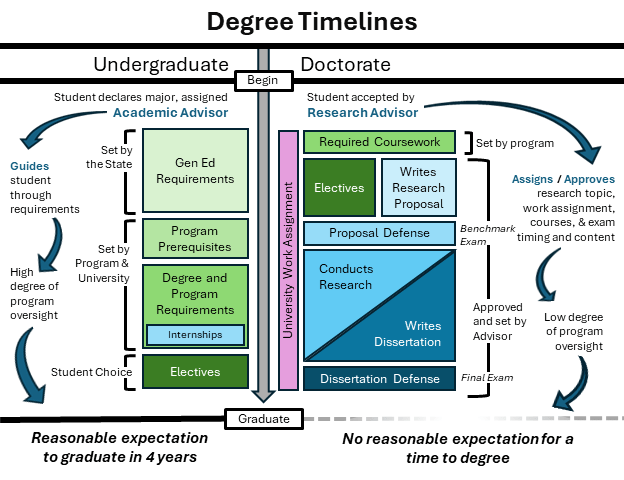
Ah, such an innocent question. Asked with nothing but the purest intent – to show interest in your friend and what they’ve been doing. After all, you’ve been to school. You know that college degrees are well-defined walk-ways, concrete paths marked with courses you must take and exams you must pass, all as you check-box your way down a list of “Degree Requirements” pre-approved by the university. So you figure that your friend has a pretty good idea of where that finish line is and that this question is a way you can show excitement about what they’re doing.

Oh, honey.

You sweet summer child.

You have no idea the emotional turmoil you just triggered.

Don’t feel bad. It’s not your fault. After all –

– this is one of academia’s best kept secrets:

There is no path.

If your friend was like most masochists high-achievers who decide to pursue a PhD, they did so with the same belief. And it wasn’t until they were already in their program, having spent years and hundreds of dollars preparing and applying, uprooted their lives and risked their financial security, and committed themselves to this path, that they learned it, too.

Unlike other kinds of higher education degree programs, PhD programs operate with a uniquely high degree of, shall we say, “independence,” from university oversight. Those who enthusiastically defend this independence – who also happen to be those who successfully traversed it and who continue to benefit materially from it – are quite adamant that it’s Simply Impossible to operate any other way. That each program is so uniquely rigorous, each avenue of research so singular, that any kind of oversight or standardization would stifle progress and make their work as researchers impossible.

While there is no doubt that research programs – which, by definition, explore areas that are not well understood – do need a degree of flexibility in order to operate, that flexibility should come through channels of exception, not default. That there is no standard even for definitions of exams, expectations of research advisor, or role of committee members is astoundingly negligent. There is no reason why universities should not have an approved framework that incorporates the common elements of a doctoral program – a reasonable number of graduate-level courses, attendance at seminars or events, requirements for proposals and exams – as well as processes by which justified exceptions can be granted, for either entire programs or single individuals. But the current modus operandi – that of allowing programs, and usually individual advisors, to have near complete control over whether a student has met the qualifications to graduate – is fundamentally antithetical to it being the capstone degree for a system of formal education. It boldly declares that the peak achievement of formal education is exempt from the fundamental assumptions of the system. 

Those who have not had the soul-crushing experience of trying to survive a PhD program might not fully understand the impact that this by-default free-reign can have on a person. This is no doubt partly because, while many of us have had had extremely stressful work environments, we’ve also been protected by employment regulations. These regulations not only help to prevent workplace mistreatment, but they provide an avenue for redress when mistreatment arises. But the majority of the work that grad students must do as part of their program are not protected by employment regulations. This is true even though they are paid by the university and their progress in the program is required in order to have the job. The program itself is exempt from regulation. So not only does this system have very little oversight over what duties are “required” of the students, there are no regulations that protect students from requirements that range from inappropriate to outright abusive. Combine this lack of oversight with the competitive nature of academic research, and you get an environment so toxic that tolerating abuse becomes a de facto degree requirement.

Right now, if you listen closely, you might be able to hear the outraged cries of academics offended at the implication of their engaging in unethical and exploitative behavior – after all, some of them do get quite loud when they yell. But if I had a dollar for every time I heard an irate university admin or faculty go off, I might have made a living wage during my program.

So how does a university determine whether or not a student is qualified to graduate? Well, PhD programs still operate under an “apprenticeship model” of education – but one that hasn’t kept up with the times. Modern trade apprenticeships are heavily regulated by commissions and government entities who license and certify craftsmen as they progress through training. In contrast, academia has held tightly to the medieval form of apprenticeship, in which students tie themselves to a “Master Researcher” (their “research advisor”) who is tasked with guiding them as they gain the knowledge and skills necessary for them to be Independent Practitioners of the Research Craft and earn the title “Doctor”. Research advisors do more than tell students what courses to take. Advisors tell them what research to do, how much to do, and how to do it, and this changes throughout the program; advisors have inordinate control over the jobs that the student is assigned, and this they are often assigned to directly assist their advisor in either conducting research or teaching courses; advisors decide whether the student has sufficiently met the advisor’s standards to qualify to take the exams to progress through each stage of the degree; and advisors approve the individual members of the student’s “Dissertation Committee” responsible for giving them exams.

An imperfect comparison of the undergraduate and doctoral degree “paths”. And before you come at us about how this doesn’t match yours, remember – that’s the point.

And what does the Master Researcher (and university) gain in return? Well, cheap labor, of course. Running a research program takes a lot of work – you need people to run lab experiments, do background research, write papers, apply for grants, teach courses, meet with students. Paying graduate students a firmly capped stipend stripped of benefits is a lot cheaper than paying faculty, adjunct or not. And if your advisor also needs help scheduling appointments, picking up dry cleaning, hosting guests, catering meals, sorting through trash for lost items… well, who else better than their apprentice? Master Researchers can’t be expected to do it all themselves, and students who are serious about their program must be willing to put in the extra hours to prove that they are worthy enough to earn the title of Doctor. Not everyone is “cut out” for academia, after all; you have to really want it. You need to prove to them that you’re willing to do what it takes. And your advisor not only allows you to graduate, but they’ll be included on every resume, CV, and job application in your future. You are tied to them for the rest of your career. You need their approval. And if you decide to leave, realizing that this isn’t for you, it hardly hurts the university – there are hundreds of students lined up to take your place at the next recruitment cycle.

I honestly wish I could write about students in grad school without it coming across as a badly written B-movie plot with villains twirling their mustaches as they cackle maniacally. But more than that, I wish that working around-the-clock and being verbally abused for setting any kind of boundary wasn’t such a ubiquitous part of doctoral “training” that students weren’t flooding mental health services, abusing substances, dropping out, and contemplating suicide at rates unheard of any other industry.

I have no doubt that if some of the greatest thought-leaders of our time would only shift the focus of their well-honed intellect from making excuses to making policies, we might actually come up with something that works. At minimum, universities should implement institution-wide policies that mirror those of basic employment regulations. The tired claim that the same kind of regulations that protect millions of employees across thousands of industries would simultaneously cripple research progress at universities is a straw man fallacy of academic proportions.

Pun intended.

Except that it really isn’t funny.

Kaylynne M. Glover, PhD
FAARM Co-Founder
Director of Communications

How to Convince Policymakers to Care (Hint: Data Isn’t Enough)

Academics often make a big mistake when they begin to work in policy: they think that data changes minds.

Don’t get me wrong; data plays a critical role in change-making. If the data doesn’t support your case, not only will you be limited in how many minds you can change, but you’re putting your reputation on the line, and the fallout might not be pretty.

But data just doesn’t compare to storytelling in how it packs a punch. Good stories turn numbers into people and statistics into reality. They engage not just our intellectual side, but our emotional one. They bring people together, connecting them, in ways that data alone just… can’t. 

And when it comes to policy, few things matter more than connecting to each other. You need people to care enough about your issue to do something about it, and caring about something is a feeling, an emotional response. After all, policy is about people – those complicated, messy, emotionally beings who lie to themselves about how logical they are. 

The fact is that if you want to change policy, you need both data and storytelling. Let’s break them down.

First, let’s talk about data. You can think of data as the bedrock of policymaking. Like underlying rock, data shapes how things appear on the surface, even if we don’t see the hidden detail beneath. Furthermore, how solid and reliable that bedrock is will affect the ability of what comes after. You want to make policy that’s backed by solid data as much as you want to make sure that you aren’t building a parking garage over a sinkhole. 

When you meet with policymakers, there are some specific advantages to having a position backed by data.

  1. Credibility. Policymakers are bombarded with information constantly. Their decision-making isn’t hampered by access to information; the difficulty lies in knowing what data they can trust. If you’re coming to the table with data behind you, that’s automatically bringing points in your favor.
  2. Specificity. It’s one thing to say that graduate students are experiencing a mental health crisis. It’s another to say that the rate of depression in grad school is six times that of the general population. Or that 1 in 10 are suicidal. Being specific gives your argument an edge that’s hard to ignore.
  3. Comparison. When you are trying to convince someone to support a specific position, numbers not only gives weight to the problem, but also to the choices: “Option A is estimated to reduce rates of depression in students by 10%, whereas Option B reduces is by 20%”. Believe it or not, (most) policymakers (usually) feel the weight of their decisions and care (to some degree) about the outcome. And if you can help them see the different outcomes of their choice, that greatly reduces the burden that decision carries.
  4. Accountability. Policies are regularly evaluated for effectiveness (now, whether the government or the people care about that evaluation is another story, but I digress). But this means that when you have a policy proposal, bringing data on both (1) current policy effectiveness and (2) potential policy effectiveness helps to narrow the degree of uncertainty – the risk – that comes from supporting a policy. Policymakers can feel more confident that they’ll have made fewer bad decisions overall if you can help them figure out the right decision first. 
  5. Clarity. Numbers bring clarity; if you are having guests over, knowing how many people will be there, what their dietary preferences are, and how long they plan to stay, will make it a lot easier for you to decide to make hand-crafted pasta or a big pot of chili. Help your policymakers see the issue for what it is, and the more you can break a complicated issue down into simpler, quantifiable elements, the more effective you will be.

So yes, data is crucial to policymaking. But it has limitations. Not only do a lot of people get overwhelmed when confronted with a bunch of numbers, but numbers lack the emotional, human component that allows them to connect easily in the first place. Data can isolate just as easily. 

Thankfully, that’s where storytelling shines.

Ahem. Allow me to indulge just a bit. My area of expertise is human evolution, and that means I could talk for way longer than I should ever be allowed to on the power of storytelling. So I’ll be brief and just say that being able to tell stories has been a key driver of human cognition. Specifically, it has given us the ability to have incredibly complex social dynamics, to take the perspective of other beings, and to share information in ways that no other species (that we’ve seen) has managed. Whether you like it or not, storytelling is an intimate component of the human identity, and that means that we connect to stories in a way that we just cannot do to data. And that means that you need to use stories on your advocacy efforts i you want to make a difference.

There are some specific advantages of storytelling, and most of them have to do with how successful they are at helping a policymaker care. After all, if you want a policymaker to take your position, you have to make them care about it first.

  1. Emotional Connection. Helping policymakers connect emotionally is a very powerful way to help them care. I mean, have you ever seen an ad for pet rescue and have to forcibly remind yourself of all the very, very good reasons you just cannot adopt another animal?? Emotions drive us; rationalization comes after.
  2. Relatability. Another way to help a policymaker care about an issue is to help them see how it relates to them or someone they care about. If they can imagine their child being a grad student, facing the kind of issues that you are presenting to them, it’ll be a lot harder for them to dismiss the very real struggles that they – and we – are facing.
  3. Memorable. Let’s face it: our brains didn’t evolve in an environment where remembering facts and statistics was key to our survival. Instead, we used stories to pass along learned lessons. After all, it didn’t matter to our survival exactly how many of our ancestors died from eating a particular berry, but being able to remember the tragic tale of Jimmy and the Purple Vine Berries could keep us safe.
  4. Accessibility. I’m going to lay it out straight: academics have earned their reputation for elitism. Academics speak using a kind of dialect that most people don’t understand, creating a barrier between them and their audience and not connection. And even though a lot of academics are comfortable dealing with data, most people do not spend a lot of time engaging with it. This means that if you are hoping that your complex and nuanced statistical analysis of a situation is going to resonate with the policymaker sitting across the table from you, I’ve got bad news for you. And let me be clear: this is not something they need to fix. You have the information; you have the responsibility to communicate that in a way that ensures understanding. There’s a famous story of Richard Feynman getting frustrated at his efforts to break a complicated physics concept down to a level that his freshmen could understand. He said that he knew it meant that he didn’t really understand it himself.

If you want to be truly compelling and persuasive, you’ve got to bring together accurate data and evocative storytelling. But this can be easier said than done. If you’re struggling to marry the two effectively, here are a few approaches you could try:

  1. Illustrate the Data. Try to turn the numbers into a narrative. Instead of describing the statistics on grad school matriculation, student work expectations, and our drop-out rates (hint: they’re bad), tell the story of Kaylynne, a mom who moved across the country with her husband and 3-year-old and how her education and work environment was so toxic that she developed multiple disabilities so severe that, by the tine she graduated 7 years later, she was disabled and unable to work. (Hi, that’s me, I’m Kaylynne – you can read more of my story here). And then you can say, “If you think this is bad, just remember: she’s not the exception. Half of all doctoral students drop out because of the stress.”
  2. Humanize the Data. Put a face on the data. After telling my story above, you can follow that up with: “How many of those with me here today have a similar story? How many personally know someone who has one? Kaylynne’s story is also my story, and his, and hers. Do you know anyone who has gone to earn a PhD? Have you talked to them about their experiences? Maybe you should.”
  3. Contextualize the Data. Saying that half of doctoral students drop out is, on its own, a powerful statistic. But the obvious counter is that there could be many reasons for someone dropping out of school: maybe they got a great job offer, or their parents needed them home, or maybe, as a lot of faculty will say, the students just “weren’t cut out” for the rigor of a PhD program. So when you can provide context for the data – when you can explain that, when asked, the vast majority of the students left because of high stress, low pay, and a poor work-life balance. How they were having to rely on food banks to feed their kids while working 50-hour weeks stuck at a computer with no HR to protect them from neglect, abuse, and exploitation.
  4. Garner Attention. Yes, yes, I’ll admit it. Stories get people’s attention. And this is not a bad thing. Yeah, you heard me: Getting attention is not a bad thing. All it does is allow the Thinking Human Being now listening to you to give you, and your position, their due consideration. Don’t cheapen their decision by presuming that they are incapable of analyzing what they hear. Once you’ve got their attention, then you can show them that they can trust you because you have the facts that back it up. If you can’t draw them in enough to convince them to listen to you, then that’s on you, not them.

As you craft your message to your policymakers, try to think of ways to incorporate both data and storytelling. Perhaps start by thinking on the stories that you’ve heard from fellow students. Which ones have resonated with you? Which ones have inspired you to take action? To care? Once you’ve picked out a few stories, think about how they fit into the data. Where do they overlap? Where can the latter illustrate the former. Then, craft your message, helping them see how the story at the surface connects the data that lies beneath. And what they can do now that they understand.

FAARM Co-Founder
Kaylynne M. Glover, PhD

The FAARM Guide to Conducting Successful Congressional Office Meetings

Advocacy plays a crucial role in shaping legislation affects the conditions for graduate and professional students across the nation. One effective way to influence change is by meeting with congressional offices. In this guide, we’ll walk you through the essential steps to conduct successful congressional office meetings.

Step 0: Wait, why should my organization do this in the first place? 

Legislation can impact all kinds of research trainees – graduate and professional students and postdocs – and it can improve working conditions in a wide variety of ways. It’s really important to remember the scope of what we’re talking about here: federal legislation can affect all research trainees nationwide. A single win could be incredibly positive for millions of people.

Congressional office meetings are essential for bringing the issues faced by research trainees to the attention of legislators and staff. A normal rank-and-file congressional office discusses at least a dozen issues with constituents and stakeholders in a regular day and hundreds over the course of a 2-year term. Not only that, but research trainees are neither a large nor a high-profile population of voters in most congressional districts. So you should assume your representatives in Congress don’t know your issues in detail – unless, and until, you tell them yourself.

Congressional office meetings are also very useful for networking and name recognition, both for the individuals participating in the meeting and for your organization.

Step 1: Manage your expectations.

It is important to keep this in perspective: your single meeting is not going to be the thing that made it possible to pass immigration reform or a FAARM Federal Framework. Big, complicated reforms require a lot of time and work, often over many years, before the conditions are right for passage. If fact, many large reforms are accomplished in small pieces over time, not as a single package. For any given meeting, it might honestly be difficult to measure how much you moved the ball forward. That’s ok. Veteran advocates from the nation’s largest advocacy organizations struggle to articulate a clear and specific way to measure the impact of a single given meeting or event. (You should definitely ask them about this any chance you get!)

I use this model, the “Fundamental Physics of Legislative Advocacy,” to help set expectations for my congressional office meetings:

  • Fast Force: Occasionally, you’ll connect with a member or staffer who is simply a true believer that likes you and your causes. They’ll do cool stuff like ask for your input on hearing questions and legislation text, mention your organization in press releases and floor speeches, or introduce bills for you. This is really awesome when it happens, but it’s very rare. Making this kind of ‘fast’ connection can require a lot of shots-on-goal.
  • Slow Force: Plenty of Congressional staffers have no experience with grad school or scientific research. Even some immigration staffers will have no idea how graduate education intersects with immigration, so they may not understand why you care about Optional Practical Training  and may not be familiar with it at all (ask the international students in your organization if you don’t get the reference!). Making more Congressional staff aware of your organization and it’s causes makes it a little more likely that, over time, positive action will be taken.

Regardless, both forces reward organizations that have as many meetings as possible. Each meeting can have an impact, even if you don’t see it right away.

Step 2: Research your members.

The importance of this cannot be understated. Each member of Congress has unique interests, experiences, and priorities – often aligned with the major features of their district. You need to learn about them and shape your “pitch” around their priorities. Ask yourself –

  • What is their history on the issues you want to discuss? Have they stated a position on your issues or your priority legislation? 
  • Are they a co-sponsor on the bills you are discussing? Were they cosponsors of any previous iterations of that bill? Remember that it often takes many years, across many Congresses, to pass substantive new legislation. Check for past versions of bills you care about.
  • Are they a member or chair of a relevant committee or caucus?
  • Do they have something in common with you or your organization? It’s good to know where your member grew up and got their college degree.
  • What are the major universities with graduate programs in their district or state?
  • How many grad students are in those programs?
  • If your ask is related to a subpopulation (e.g., international students), how many of that subpopulation are in those programs?

Step 3: Craft your pitch!

Now that you know your audience, you can create a message tailored to them. There are some important things to consider as you do so:

  • How much time do you have? This is key to deciding how to prioritize your discussion points. Be prepared to trim it down to the bare bones, but also be prepared for a longer discussion and follow-up questions.
  • Who’s talking about each of your issues or priority legislation? It can be very helpful for members of your team to strategically target their efforts, each focusing their prior research on a small set of issues or legislation.
  • What are your talking points for each issue or bill?
    • Be familiar with the general background and recent news on the issue or bill.
    • Be prepared to share 1 or 2 hard-hitting and salient facts.
    • Where possible, tell a story! Make use of personal experience to the greatest extent possible.
  • What are your asks?
    • Being practical and realistic helps ensure your team will be taken seriously. Can the Member of Congress do what you’re asking for?
    • Common example asks include:  Introduce a bill, cosponsor an existing bill, write a letter, ask a question in a hearing, attend an event, etc. 
  • Do you have a one-pager or statement for each of your issues or priority legislation? It’s an extremely good idea to produce a one-pager or statement in advance on each issue or bill you want to talk about!

Step 4: Contact offices and request meetings. 

First and foremost, don’t overthink this. Email is almost always the best way to get in touch with a Congressional office. It’s entirely ok to use a generic utility address (like scheduling@member.senate.gov) or a ‘Meeting Request’ form that you’ll find on their websites. You can usually get a swift reply, but if you don’t get a reply within a week, you may need to call the member’s DC office. If you’re a constituent of that member (you live in their district), make sure to say so in any emails, form responses, or phone conversations. If you’re not, consider getting a constituent to help with outreach to that office, since constituents are far more likely to get prompt responses to meeting requests. Include any one-pagers or statements your organization has produced on your issues or your priority legislation in the meeting request, if possible. Start reaching out to request meetings 3-4 weeks before your lobby day event or target meeting date.

Be aware up front that you will probably not talk directly to the Member of Congress. You will probably meet their education, immigration, or science staffer, and it’s very helpful to state clearly in your meeting requests that you’re ok with meeting with staff if the member is not available. You will usually have 15 – 30 minutes, depending on the office and on whether the member will be able to join the meeting. But know this – meeting with staffers is no less impactful than meeting with a member, so don’t feel like you won’t be able to make a difference.

If your organization has met with a given office in the past, reach out to the staff you met with previously to request your meeting. This is a great way to build a relationship with that office and maximize your likelihood of a prompt response. (Make sure your organization saves good records and notes on each Congressional office meeting! Don’t overthink this part, either – a Google Drive folder, a spreadsheet, and a Google Doc is plenty. Just make sure your successor knows where to find them!)

Step 5: Conduct your meetings!

The office may have anywhere between 1 and 3 staff to meet with you; it’s appropriate for you to bring 2-4 team members to each meeting. (You’ll see some kinds of advocacy groups that fill offices with a huge crew in matching shirts and whatnot; you do not need to do this, and you’ll probably start seeing that there are some real practical drawbacks to this approach after you run into a few groups like this during your meetings.) Don’t be surprised if you end up having meetings in some oddly arranged – or just plain odd – rooms. FAARM Core Team members have had meetings in hallways, cubicles, and a couple different kinds of utility or storage spaces.

Before you go in, decide who on your team will direct traffic and who will take notes during the substantive parts of the meeting. Don’t be surprised when lots of Congressional staff pull out a paper notepad to take their notes, and you should consider doing the same yourself. It’s fairly customary to exchange business cards at the beginning of the meeting, but if they don’t, be sure to request theirs at the end.

Once the meeting has started, follow your plan, be friendly, and don’t overthink things! Make sure you introduce each member of your team, what you study, and where. Discuss your issues and bills in the order you planned before the meeting, and make sure your level of detail is appropriate to the time available. Answer follow-up questions from the staffers as well as you can, and try to stick to the planned schedule and be finished at the planned time – they have very little flexibility to their schedule.

When you finish, be sure to thank them for the meeting. Always let them know they can contact you or your organization if they have questions about your community’s concerns and how legislation could impact them. Being a good resource helps build relationships. 

Everyone says the same thing starting out: “We’re gonna play error-free ball.” But then the unforeseen happens. It’s unavoidable. What matters then is how good an audible you call. The difference between a successful presidency and a historical footnote is how well you roll with the punches, just to complete my tour of sports metaphors.

Josh Lyman, The West Wing, S7E19

Congressional office meetings are often more of a conversation than a presentation, and that means they may go unexpected directions. If the staff you’re meeting with ask you a question that you can’t answer, be honest about it: maybe you don’t have the data needed to answer it – maybe it doesn’t even exist yet – but maybe you can look into it and get back to them later. But whatever the question is, be plain, honest, and direct in your answers: don’t make things up, and don’t feel like you have to have all of the answers. This will earn their respect and trust; Members of Congress and their staff can usually tell if you’re blowing smoke. Instead, take note of the questions asked and answer as much as you can in a follow-up email after the meeting.

Step 6: Follow up afterwards.

Make sure you send a follow-up email for every single Congressional office meeting you conduct! Thank everyone you met with for their time (again) and answer any unanswered questions from the meeting. Resend your one-pagers. as well as any other documents discussed in the meeting, so that they’ll be easy for them to find (and share) when they need to (they generally prefer electronic copies of things, anyway). And be sure to offer yourself and your organization as a resource for your community and its concerns.

If you’re planning to discuss the FAARM Federal Framework or any of our Immediate Needs or other proposals, let us know at faarmteam@gmail.com, and we’ll be happy to support your Congressional office meeting planning. All kinds of research trainees are always welcome to use any of our materials that may be helpful for your advocacy work.

Good hunting!

Daniel Curtis

FAARM Co-Founder


I’d spent years navigating “difficult” supervisors in higher ed, and I thought I would be able to weather it.

And I did – like beach-front property in a hurricane.


When I decided to get my PhD, I thought I knew what I was getting into. I was 30 and had worked in academia for 5 years as an advisor and instructor. I knew that universities were facing existential threats, both political and financial, and that faculty were workaholics who claimed they loved working in higher education for the “flexibility” and the “rigor”. Which all sounds great until you realize that this combination creates a pressure cooker of competition that leaves everyone working around the clock and feeling like they’re never enough.

I didn’t want any of that. I had no interest in long-term research or working at a university, but I did want to gain first-hand experience in scientific research. My passion has always been science communication, and I believed a PhD would be an essential ingredient to my work.

So not only did I search for an advisor who supported my non-academic goals, I was aware enough to ask other students what it was like working with their advisors. Thus, by the time I started my program, I knew that my advisor had a reputation for being “difficult” and “demanding,” particularly when it came to ensuring that his students were working enough. But I’d spent years navigating “difficult” supervisors in higher ed, and I thought I would be able to weather it.

And I did – like beach-front property in a hurricane.


Even though graduate students are both students and employees, they receive very few protections as either.


The dirty secret is that only half of doctoral students graduate. The rest drop out, most often due to “poor work-life balance” and “poor relationship with research advisor.” The culture of graduate education is so toxic that, while in their programs, grad students develop mental health problems at rates six times that of the general population. They’re almost as likely to develop a mental health disorder as they are to graduate, and one in ten doctoral students are suicidal. This problem isn’t isolated to specific programs or universities; the trends cross departments, universities, and countries. It’s endemic to graduate education.

Even though I thought I knew higher ed, I had no idea what doctoral students were experiencing. When I began my program, I was confident that I would be able to manage the stress, meet my goals, and move on, with pride. I pursued policy-related professional development experience and put my experience in higher ed to good use as I became involved with graduate student government, first at my university, then at the national level. And I quickly learned that things were much worse than I had thought. My own experiences mirrored my conversations with students, where story upon story depicted a bleak picture filled with brow-beaten students desperate to escape. The trend was universal – graduate student mental health had been plummeting for a decade.


Only half of doctoral students graduate.


As I advocated for students at the university and in Congress, I became frustrated with just how little recourse students had. See, as it turns out, even though graduate students are both students and employees, they receive very few protections as either. Most of the federal protections for students center on classroom-related issues, like grades and exams – not verbal abuse in lab meetings or being forced to teach courses uncompensated because your advisor is “too busy.” But as employees, our protections end at “official” duties, like when we’re in a classroom teaching, not the interactions that we have with our advisors who oversee our education, even though they often dictate our employment responsibilities. As a result, very few of the types of interactions that we have with our “bosses” are protected under either set of regulations – and they just happen to be competitive workaholics suffering from imposter syndrome.

I did manage to survive my program, but I left broken. I developed a host of chronic health conditions tied to extreme stress and overwork, and I am now disabled. During my program, I spent about 60 hours a week working on either my research, my courses, my teaching, or doing professional development. If I wasn’t asleep or eating, I was working, at a doctors’ appointment, or, if I was lucky, putting my young son to sleep. And it still wasn’t enough for my (first) advisor, whose verbal abuse and harassment eventually led to every student leaving his lab – at around the same time we learned that not a single doctoral student had graduated from his lab in 10 years, a fact that had been conveniently hidden from us during recruitment. Still, the work hours didn’t get any better after leaving his lab, and so, over the years, I kept telling myself that this wouldn’t last forever, that things would get better once I graduated. I just needed to stick it out long enough. I almost didn’t make it.


There is an entire subclass of our population – students, no less – whose federally funded working and learning environments is somehow exempt from standard protections and whose treatment by their employers receives little to no oversight.


Working long hours, particularly on a computer, led to me developing what one doctor termed, “widespread musculoskeletal dysfunction.” It began as neuropathic pain in my arms that, no matter what I did, wouldn’t go away. I spent approximately 75% of my 7-year program in physical therapy, though I couldn’t see my PT as regularly as I needed to because my student insurance capped me at 12 visits a year. I invested a lot of personal money into creating an ergonomic computer set up at home – and was subsequently criticized for not working in the office, even though the school wouldn’t help me with the necessary accommodations. I created splints out of chopsticks and ace bandages to strap my arm into so I could keep working when the pain got really bad. I developed ulcers from chronic NSAID overuse and ended up in the ER with internal bleeding. I developed constant pain at the back of my head, eventually diagnosed as occipital neuralgia, and during the last 18 months of my program, I suffered from chronic, intractable migraines. It took over two years of trying to find an effective treatment before I finally had surgery – occipital nerve release – during which they found extensive soft tissue nerve entrapment. The long hours at a computer had allowed the muscles and fascia in my neck to literally grow up and around my occipital nerves, effectively trapping them down and causing constant pain. It was so extensive that the surgery took nearly twice as long as expected. As I write this, I am 6 weeks post-op, and for the first time in I-don’t-know-how-long, I have no pain at the back of my head. And yet, we still suspect there is additional nerve entrapment elsewhere in my neck, though we’re hoping to loosen it with more conservative treatments.

The long-term health problems that come from long work hours is well-documented. “Regulations are written in blood,” and employee welfare laws are no different. Workers and activists fought for 80 years to establish the federally protected 40-hour work week, and it has been law for almost the same amount of time. Workers’ compensation laws have been enacted in every state since 1948. And yet, there is an entire subclass of our population – students, no less – whose federally funded working and learning environments is somehow exempt from these protections and whose treatment by their employers receives little to no oversight.


For many graduate students, whether they earn their degree becomes dependent upon how much abuse they are willing to tolerate.


My story is not unique. Only half of us manage to finish, and with each dropout, we hear the same narrative: “They didn’t want it enough,” “They weren’t passionate enough,” “They weren’t willing to sacrifice.” But there’s a reason that doctoral exams have long been regarded as a form of “academic hazing,” and while it may be tempting to say, “Graduate students are adults and can say ‘no’,” doing so ignores the power imbalances at play. The students who do push back, who do insist on boundaries with their advisors, are retaliated against – in funding decisions, teaching assignments, authorship positions – on top of whatever verbal abuse they might have to deal with. When my advisor’s harassment began to include blatant sexual harassment, my university’s Title IX office told me that, while no one should have to go through what I went through, there wasn’t enough class-based discrimination for them to do anything about it. See, he was verbally abusive to the men in his lab, too.

I sincerely believe that the vast majority of advisors are good people who would never intentionally cause harm. I don’t believe that my advisor was – or is – a bad person. But I do believe that academia breeds obsessive passion, which, unchecked, can lead to exploitation, neglect, and abuse. Academia recruits into its ranks those with near unquenchable curiosity, and then it rewards productivity without enforcing the corresponding checks and balances that protect the health and welfare of employees. With the added external pressure to “do more with less” in a publish-or-perish world, faculty are left overworked and overburdened, and they expect the students they train to keep up. Meanwhile, unaware students seek out the best researchers to train under, and then, to their dismay, often find that “best researcher” does not mean “best boss,” “best advisor,” or “best educator.” They then find themselves committed to a program without the recourses available to most employees, and because of the highly specialized nature of their work, they can’t just “find another job” or “transfer to another program.” And so, whether they earn their degree becomes dependent upon how much abuse they are willing to tolerate.

The system is broken, and its breaking us in return.

Kaylynne M. Glover, Ph.D.
FAARM Co-Founder and Policy Director